



Ford Dashboard Symbols and Meanings Guide

You’re driving home when a new symbol suddenly appears on your dashboard. Is it something you can address later, or is it a warning to pull over immediately? If you’re unsure, you’re not alone.
Modern Ford vehicles are equipped with advanced onboard diagnostics that monitor everything from engine performance to tire pressure. When the system detects a change, it communicates through dashboard warning lights. Understanding Ford dashboard symbols and meanings can help you respond appropriately, protect your vehicle, and avoid turning a minor issue into a costly repair.
Understanding Ford Dashboard Warning Light Colors
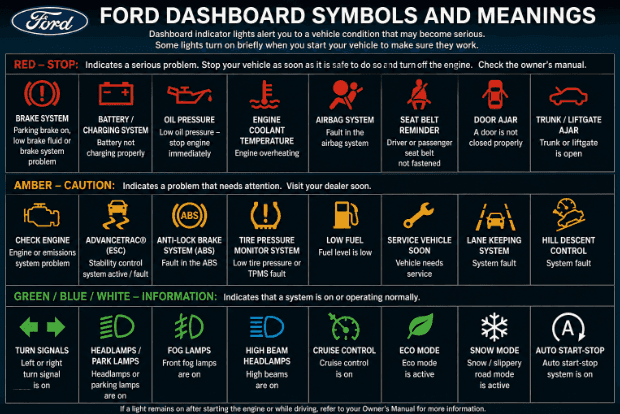
Before identifying a specific symbol, look at its color. Ford uses a simple color-coded system to indicate how urgent the warning is.
Red warning lights indicate a serious issue that requires immediate attention. These warnings often involve critical systems like engine oil pressure, coolant temperature, or braking performance. If a red light appears while you’re driving, pull over safely as soon as possible and determine whether it’s safe to continue.
Yellow or amber warning lights signal that a system needs attention soon. While you can often continue driving for a short time, these warnings shouldn’t be ignored. Scheduling an inspection early can help prevent more extensive repairs.
Green and blue indicator lights are informational. They simply let you know that a feature such as your high beams, cruise control, or turn signals is active and operating as intended.
Common Ford Dashboard Symbols and Meanings
Some dashboard warning lights appear more often than others. Here are a few of the most common Ford dashboard symbols and what they mean.
- Check Engine Light: This light indicates that your vehicle’s onboard diagnostic system has detected a problem affecting the engine, emissions system, or powertrain. The issue could be as simple as a loose gas cap or as complex as a faulty sensor or ignition component. A steady light should be inspected soon, while a flashing light indicates a more serious condition that requires immediate attention.
- Oil Pressure Warning: Displayed as an oil can icon, this warning means the engine isn’t maintaining proper oil pressure. Without adequate lubrication, internal engine components can wear rapidly, making this one of the most important warning lights to address.
- Engine Temperature Warning: If this symbol appears, the engine is running hotter than normal. Low coolant levels, cooling system leaks, or a failing thermostat are common causes. Continuing to drive with an overheating engine can lead to severe mechanical damage.
- Battery Charging System Warning: A battery-shaped icon indicates a problem with the charging system. This may be caused by a failing alternator, worn drive belt, weak battery, or electrical fault that prevents the battery from charging properly.
- Tire Pressure Monitoring System (TPMS): This warning light means one or more tires are below the recommended pressure. Driving on underinflated tires can reduce fuel efficiency, affect handling, and cause uneven tire wear.
Why Dashboard Warning Lights Matter
Every dashboard warning light is triggered by sensors that continuously monitor your Ford’s critical systems. While some lights are simple reminders, others are designed to alert you before a small problem becomes a major repair. Paying attention to these warnings can improve safety, extend the life of your vehicle, and help you avoid unexpected breakdowns.
Understanding Ford dashboard symbols and meanings isn’t just about recognizing icons; it’s about knowing when your vehicle is asking for attention. The more familiar you are with these dashboard indicators, the more confident you’ll be when a warning light appears.
More from Kenny Ross Ford South
Which Ford Models Are Hybrids?
What if you could spend less time at the gas pump without having to completely change the way you drive? That is the appeal of a hybrid. By combining a gasoline engine with electric motor assistance, Ford hybrids deliver a different kind of driving experience one that can be efficient during the morning…
Ford Bronco Sport Ground Clearance: Is It High Enough for Off-Roading?
If you’ve ever been looking at a trail and come across a sign that says “High Clearance Vehicles Only,” you may have stopped for a second and looked at your Bronco Sport a little differently. Is 7.8 inches enough? What about the Badlands with 8.8 inches? And does that number actually tell you whether…
Does a Ford Raptor Qualify for Section 179?
If you’re a business owner looking for a powerful truck that can handle demanding jobs while potentially offering valuable tax benefits, you may be asking: Which Ford vehicles qualify for Section 179? Whether a Ford Raptor qualifies for Section 179 depends on its specific configuration and if it meets the IRS’s current requirements….